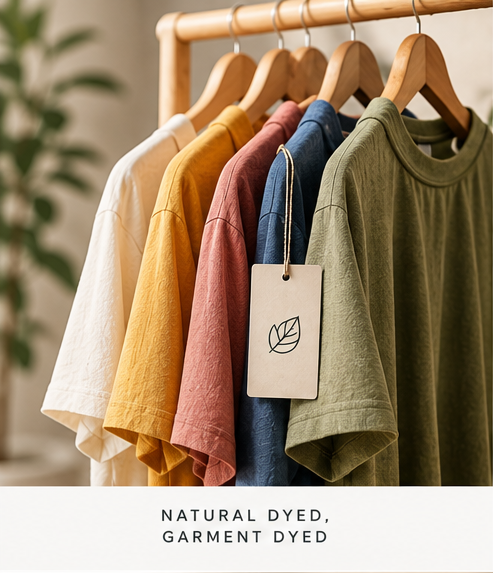
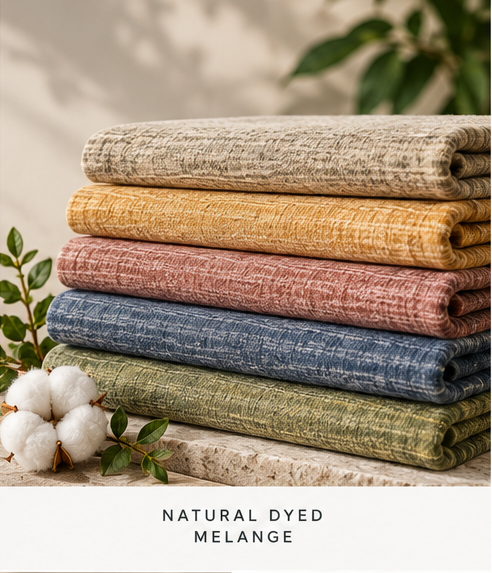
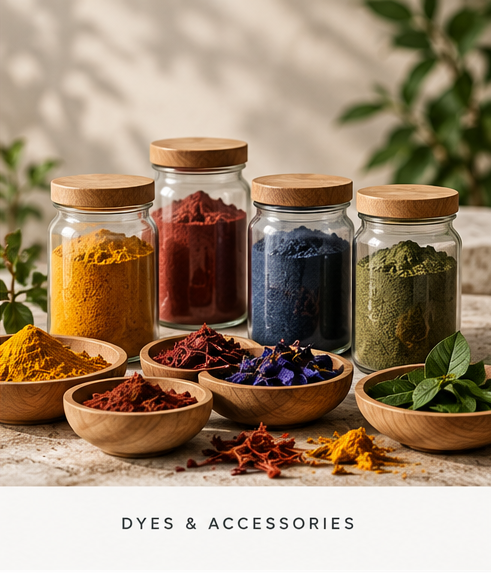
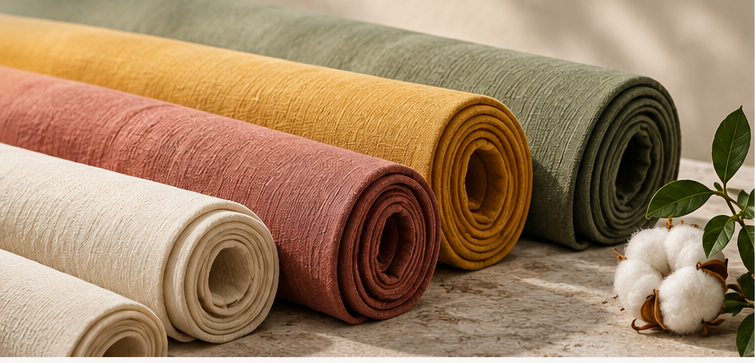
Inspired from nature
Nature's way, in every way
Roughly 8,000 chemicals can touch a garment before it reaches you — toxins, carcinogens, allergens, all of it eventually washing into rivers and back onto our plates. We dye with plants instead, from seed to garment, with zero synthetic chemicals.
Every batch dyed by hand carries its own hue — no two vats come out quite the same.
The problem
synthetic chemicals can be used across the production and processing of textiles — before a single garment reaches a wardrobe.
These chemicals don't stay in the factory. They run off into water bodies, move through the food chain, and eventually turn up on our own plates. Even a "GOTS certified" garment is usually only chemical-free up to the raw cotton stage — the bleaching, dyeing, and finishing that follow are still done with synthetic inputs.
Natural dyeing has existed as an alternative for centuries, but the current scene is small and strained: labour-intensive, limited to small batches, inconsistent from run to run, prone to poor fastness on cotton, and priced out of reach for most brands.
| Feature | Natural Dyes | Synthetic Dyes |
|---|---|---|
| Source | Extracted from plants, flowers and roots | Derived from petrochemicals and industrial chemicals |
| Environmental impact | Biodegradable, minimal pollution | Often toxic and non-biodegradable |
| Health effects | Generally safe, gentle on sensitive skin | Can trigger allergies and skin irritation |
| Innovation | Limited by nature, but expanded by dye NATA | Highly customizable shades and effects |
| Sustainability | Renewable, highly sustainable | Reliant on non-renewable resources |
| Waste management | Organic — becomes compost or manure | Hazardous, needs careful disposal |
| Market perception | Rising fast with eco-conscious buyers | Dominant on cost and availability |
The solution
We didn't invent natural dyeing — we made it dependable enough to build a supply chain on.
Nature's way, in every way — that's the standard we hold every batch to, seed through to seam.
Centuries-old dyeing craft, re-engineered with modern machinery so it can actually scale.
Our proprietary process closes the gaps that kept natural dyeing niche: consistency, fastness, and cost.
How dye NATA works
How we're different from other dyers
Our process delivers results on par with regular, organic-certified synthetic dyes — batch after batch.
Modern machinery gets us genuinely good washing fastness, not just a lucky run.
A true zero-synthetic-chemical process — unlike standard GOTS routes, which still rely on synthetic dyes.
Modern machines mean manual labour is barely needed, keeping production cost to a minimum.
Core benefits
Seed to garment, with no synthetic chemicals anywhere in between.
Non-carcinogenic, hypo-allergenic, and soft on sensitive skin.
Effluents are 100% organic — solidified, composted, and returned as manure.
Priced on par with other popular organic-certified brands.
Beyond the garment itself: fibre properties stay intact, the carbon footprint shrinks, traditional artisans and natural-dye farmers get sustained work, and parents and caregivers get one less thing to worry about.
What natural dyeing asks of you
Unique by nature: natural dyes produce shades no synthetic formula can replicate, and every batch carries its own one-of-a-kind hue. The earthy, muted tones connect a garment back to the plant it came from.
Artisanal by design: small shifts in colour between runs are the fingerprint of hand-dyeing, not a flaw. We treat that variability as room for designers to work with, not around.
Slow, on purpose: a longer dye cycle means more care and attention per batch, in step with the slow-fashion shift away from disposable clothing.
An investment, not a markup: the price reflects real craftsmanship and materials that are genuinely better for people and the environment — while dye NATA keeps that premium as small as possible.
Solved through partnership: dye NATA improves consistency at scale, and our Farmer Producer Company network gives us a decentralized, reliable supply of organic cotton and dye sources — while training farmers in sustainable practice along the way.
Character over time: natural dyes can fade a little faster, giving garments a lived-in, vintage quality. We're actively developing techniques to extend that vibrancy further.
Product categories
Category 1
Category 2
Category 3
Accreditations & approvals
Seed to garment, synthetic-chemical free — built for brands who want sustainability that actually holds up on the rack.